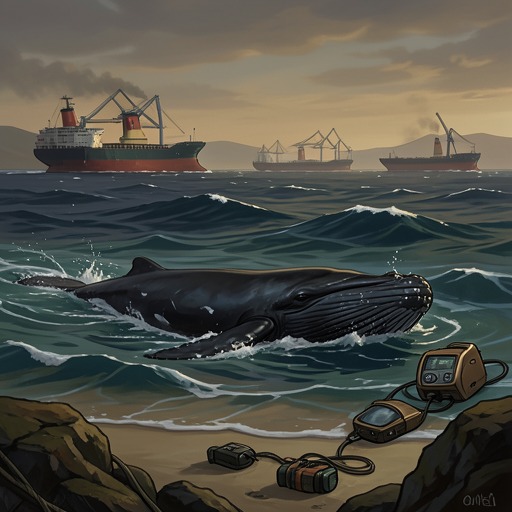
North Atlantic right whale endangerment
The WhaleNorth Atlantic right whale endangerment is a crisis in which traits that once made the species easy to hunt still expose it to danger, while the small number of surviving breeding whales magnifies every loss. Fewer than 400 remain in the North Atlantic. Hunting pressure has given way to hazards including fishing gear and vessel traffic, and legal protection has not yet produced a recovery sufficient to secure the species’ future.
A species shaped by exploitation
The right whale’s physical characteristics made it especially vulnerable to commercial hunting. With about 40 percent of its body composed of fat, it was buoyant and floated when killed; it also tended to remain close to shore. Its blubber supplied valuable oil, while its long baleen could be shaped into products such as umbrella frames, corset stays, blinds, and brush bristles. These features helped make the species one of the earliest targets of whaling. Centuries of predation reduced the North Atlantic population to fewer than 400 animals.
The biological consequences are more severe than the remaining count alone suggests. Although right whales are reproductively capable, only eight matrilineal lines remain in the northern population, a narrow legacy of prolonged hunting. This restricted genetic base compounds the risk posed by low numbers of breeding animals. The species’ capacity to reproduce has not erased the accumulated effects of its history.
Protection and continuing hazards
The right whale became the first cetacean protected from hunting, in 1935. Yet its North Atlantic numbers remained static despite further measures, including shifting a shipping lane north and instructing vessels to stay 500 yards away from whales. Protection from deliberate hunting therefore did not remove the dangers associated with the busy coastal waters the animals inhabit.
The same surface-dwelling behavior that once made right whales accessible to hunters leaves them exposed to present-day threats. They can remain silent and still at the surface, where ships may not avoid them. Fishing line is another serious hazard: more than 60 percent of right whales have been caught in it. Ship strikes kill more animals than had previously been suspected, including females of calf-bearing age. When breeding females are lost from an already small population, the consequences extend beyond the individual animal to the species’ prospects for producing future generations. The book warns that, with so few breeding whales and such a restricted gene pool, the species may not survive the century.
Conservation and rescue
Stormy Mayo’s involvement began when he saw his first right whale as a sixteen-year-old fishing with his father on Stellwagen Bank. The animals were already close to extinction, and their locations were poorly known. That youthful interest became a sustained conservation effort: Mayo helped found the Center for Coastal Studies in Provincetown in 1976 and began collecting data on right whales. He also became the first person licensed by the government to rescue entangled whales.
Rescue work adapts equipment and methods once associated with whaling to a different purpose. Responders approach an entangled whale by boat and use sea anchors to slow it; Mayo, wearing protective equipment and a camera helmet, uses a long-handled hook to cut fishing line. The operation reverses the logic of the hunt: tools for controlling a whale’s movement are used in an attempt to free it from human-made danger. The account presents Mayo and his colleagues as conservation workers responding to urgent cases, sometimes at short notice and at substantial cost.
A wider extinction warning
The right whale’s danger forms part of a broader account of human-driven loss. The book describes wildlife disappearing at an average rate of one hundred species a day and notes that, while it was being written, the Yangtze River dolphin had been declared extinct. It warns that half of all animal species could follow by the end of the century, including the right whales of Cape Cod Bay. That forecast is presented as a warning, not a certainty; for the North Atlantic population, the combination of few breeding animals, limited matrilineal lines, entanglement, and vessel deaths makes the possibility of extinction difficult to dismiss.